Caleb Williams Ranked No. 1 in the NFC North Over Jordan Love? One Statistic Explains Why the Debate Is Far From Over
Caleb Williams Ranked No. 1 in the NFC North Over Jordan Love? One Statistic Explains Why the Debate Is Far From Over
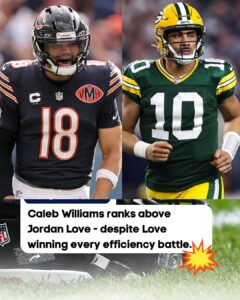
Few quarterback debates entering the 2025 NFL season are as compelling as the one between Chicago Bears star Caleb Williams and Green Bay Packers quarterback Jordan Love. Both signal-callers have established themselves as franchise leaders, and both carry enormous expectations into what could become a defining season for the NFC North.
Recent quarterback rankings have sparked heated discussions by placing Caleb Williams at the top of the division, ahead of Jordan Love. While many fans applauded the recognition of Williams’ rapid development, others questioned whether the numbers actually support that conclusion.
At first glance, Jordan Love appears to have the statistical advantage.
He posted a higher completion percentage, a better passer rating, and threw fewer interceptions than Williams over the previous season. Those are traditionally three of the most important metrics used to evaluate quarterback efficiency. They reward accuracy, decision-making, and the ability to protect the football—qualities every franchise values.

So why has the conversation shifted toward Caleb Williams?
The answer may lie in one overlooked statistic.
Williams attempted 129 more passes than Love.
That single number dramatically changes the context of the comparison.
Throwing more passes means carrying a larger share of the offense. It also means facing more opportunities to make mistakes, more pressure situations, and more defensive adjustments designed specifically to slow you down. Despite the heavier workload, Williams continued to produce at a high level, leading many analysts to argue that his overall impact extended beyond traditional efficiency statistics.
Volume and efficiency have always been difficult to compare.
A quarterback who throws 430 passes can often maintain higher efficiency numbers than one attempting well over 550 throws. More attempts typically lead to tighter passing windows, increased defensive attention, and greater physical wear over the course of a season.
That is exactly what makes the Williams-Love debate so fascinating.
Jordan Love deserves enormous credit for his consistency. Since taking over as Green Bay’s starter, he has demonstrated impressive accuracy and poise. His ability to limit turnovers while maintaining a strong passer rating has helped keep the Packers among the NFC’s most competitive teams. Recent career statistics continue to reflect his efficiency as one of the conference’s most productive quarterbacks.
Meanwhile, Caleb Williams has taken a different path.
Rather than relying solely on efficiency, the Bears have increasingly placed the offense in his hands. Williams has been asked to throw more frequently, extend plays with his legs, and generate explosive opportunities under pressure. That heavier responsibility has naturally affected some statistical categories, yet it has also showcased his ability to shoulder an offense that continues to evolve around him.
Supporters argue that context matters just as much as raw numbers.
A quarterback who consistently attempts more passes often faces more third-and-long situations, more comeback drives, and greater expectations to rescue stalled possessions. Every additional dropback increases the possibility of sacks, incompletions, or interceptions.
Viewed through that lens, Williams’ production becomes even more impressive.
His supporters believe the additional workload offsets some of the efficiency gap between himself and Love. Instead of focusing exclusively on completion percentage or passer rating, they emphasize leadership, offensive responsibility, and the ability to create plays when everything breaks down.
On the other hand, Green Bay fans point out that efficiency wins football games.
Accuracy keeps drives alive.
Limiting interceptions protects field position.
Higher passer ratings generally reflect smarter decision-making throughout a season.
From that perspective, Love has earned every bit of recognition he receives.
Both viewpoints contain legitimate arguments.
Football has evolved beyond evaluating quarterbacks through a single statistic. Modern analysis considers completion percentage over expectation, success rate, explosive plays, third-down performance, red-zone efficiency, pressure response, and situational football.
That broader evaluation often paints a more balanced picture.
Williams excels at creating opportunities outside structure. His athleticism allows him to escape pressure, extend plays, and challenge defenses vertically. His confidence encourages aggressive decision-making, even when the risk level increases.
Love, meanwhile, thrives within rhythm.
His mechanics remain consistent, his ball placement is reliable, and his decision-making frequently minimizes costly mistakes. Green Bay’s offense benefits from his calm presence and efficient execution.
The contrasting styles explain why rankings continue to divide analysts.
Some prioritize efficiency.
Others value workload.
Some reward production.
Others emphasize consistency.
As a result, placing one quarterback ahead of the other often depends on which metrics receive the greatest weight.
Perhaps that is why the upcoming 2025 season feels so significant.
The debate no longer revolves around potential.
Both quarterbacks have already demonstrated they can succeed in the NFL.
Now comes the next challenge: proving they belong among the league’s elite over an entire season while leading playoff-caliber teams.
For Williams, expectations continue to rise.
The Bears have invested heavily in surrounding him with offensive talent, and the organization believes he possesses the ability to transform Chicago into a legitimate championship contender. Analysts have highlighted his rapid development and franchise-record production as evidence that he is moving toward elite status.
For Love, the challenge is equally clear.
After establishing himself as Aaron Rodgers’ successor, he must continue proving that Green Bay remains one of the NFL’s most stable quarterback organizations. Maintaining elite efficiency while delivering postseason success would strengthen his argument as the NFC North’s premier signal-caller.
Ultimately, statistics alone cannot settle this debate.
Completion percentage matters.
Passer rating matters.
Interceptions matter.
But so do leadership, workload, situational performance, and the ability to elevate teammates when games matter most.
The difference of 129 pass attempts serves as a reminder that numbers rarely exist in isolation. Every statistic carries context, and every quarterback operates within a unique offensive system.
That is why the 2025 season represents more than another year on the schedule.
It is an opportunity for both quarterbacks to redefine the conversation.
If Caleb Williams continues thriving despite carrying one of the NFL’s heaviest passing workloads, his supporters will argue that the rankings were justified all along.
If Jordan Love once again posts superior efficiency while leading Green Bay deep into the postseason, critics will insist that consistency ultimately outweighs volume.
Either way, fans across the NFC North are about to witness one of football’s most compelling quarterback rivalries.
One quarterback has the efficiency.
The other has the workload.
Now the only statistic that truly matters is wins.
And by the end of the 2025 season, the debate that has dominated the NFC North may finally have its answer.