💰 SHOCKING TRUTH: One Bad Season Can Bankrupt a $5 Million Crab Boat—Why Bering Sea Captains Risk Everything Every Year
💰 SHOCKING TRUTH: One Bad Season Can Bankrupt a $5 Million Crab Boat—Why Bering Sea Captains Risk Everything Every Year
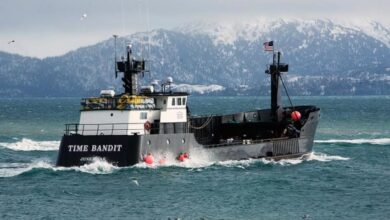
For millions of viewers around the world, Deadliest Catch has become synonymous with towering waves, freezing temperatures, and fearless captains battling the unforgiving waters of Alaska’s Bering Sea. Every episode showcases dramatic storms, overloaded crab pots, and split-second decisions that determine whether a crew returns home safely.
Yet behind every dangerous voyage lies another battle that cameras rarely capture.
It is not fought against the ocean.
It is fought against the balance sheet.




Owning and operating a commercial crab boat in the Bering Sea has become one of the most expensive—and financially risky—businesses in the fishing industry. While viewers often celebrate record catches and heroic seamanship, the reality is that many captains gamble millions of dollars every season before hauling their very first crab pot.
For vessel owners, the season begins months before leaving Dutch Harbor.
The first challenge is preparing the boat itself.
Most Bering Sea crab vessels are decades old and require constant maintenance. Engines must be rebuilt, hydraulic cranes inspected, electrical wiring tested, navigation electronics updated, refrigeration systems serviced, and safety equipment certified before regulators allow the boats to leave port.
Every repair comes with a price.
Replacing a single hydraulic component can cost thousands of dollars.
Engine overhauls can climb well into six figures.
Unexpected mechanical failures discovered during preseason inspections often force owners to spend even more simply to remain operational.
Unlike ordinary businesses, postponing repairs is rarely an option.
Hundreds of miles from shore, even a relatively minor equipment failure can become life-threatening.
After maintenance comes another enormous expense—fuel.
Commercial crab boats burn tremendous amounts of diesel while traveling between ports, searching for productive fishing grounds, hauling heavy steel crab pots, and running powerful onboard machinery twenty-four hours a day.
Fuel prices fluctuate constantly.
A sudden increase in diesel costs can erase much of a season’s expected profit before fishing even begins.
Captains carefully monitor fuel consumption because every unnecessary mile traveled directly affects the vessel’s bottom line.
Then there are the crab pots themselves.
Each heavy steel pot represents another significant investment.
A typical vessel carries hundreds of them, and each requires regular inspection, repairs, replacement ropes, buoys, identification tags, bait containers, and corrosion protection.
Storms frequently damage or destroy equipment.
Sometimes entire strings of crab pots disappear beneath rough seas.
Recovering or replacing lost gear adds thousands of dollars to operating costs.
Insurance represents another unavoidable expense.
Commercial fishing remains one of the world’s most hazardous occupations, and insurers recognize that reality.
Policies covering vessels, machinery, crew members, liability, and environmental risks are extremely expensive.
Without adequate insurance, most captains would never be able to secure financing or legally operate their vessels.
Even with comprehensive coverage, deductibles following accidents can be substantial.
Crew wages create another major financial responsibility.
Unlike many industries where employees receive fixed salaries, commercial fishing often operates using a share system.
When the season is successful, crews benefit directly.
However, captains must still provide food, survival equipment, accommodations, medical supplies, and safe working conditions throughout the voyage.
Finding experienced deckhands has also become increasingly difficult.
The work is physically demanding.
Conditions are dangerous.
Many younger workers pursue less hazardous careers, forcing captains to compete for skilled crew members.
Government regulations add another layer of complexity.
Alaska’s crab fisheries operate under strict scientific management designed to protect crab populations for future generations.
Fishing seasons are limited.
Harvest quotas are carefully controlled.
Every captain must comply with detailed reporting requirements, vessel inspections, licensing rules, and conservation measures.
These regulations support long-term sustainability but also restrict how much crab can be harvested each season.
For owners carrying large operating expenses, smaller quotas often translate into tighter profit margins.
Weather remains the industry’s greatest wildcard.
Unlike factories or offices, commercial fishing depends entirely upon environmental conditions beyond human control.
A week of severe storms can keep vessels tied to the dock.
Ice accumulation may force captains to suspend operations.
Heavy seas can damage expensive equipment.
Every weather delay means continued operating expenses without corresponding income.
Time itself becomes another financial cost.
Every day spent searching for crab consumes fuel, food, wages, and maintenance resources.
Finding productive fishing grounds has become increasingly challenging as crab populations shift and environmental conditions evolve.
Captains often relocate multiple times during a season before discovering profitable areas.
Every relocation represents another financial gamble.
Technology has helped reduce uncertainty, but it cannot eliminate risk.
Modern vessels now feature advanced radar, satellite communications, digital chart systems, sonar equipment, electronic engine monitoring, and sophisticated weather forecasting tools.
These investments improve safety and efficiency.
However, installing and maintaining such technology requires significant capital.
A single navigation upgrade may cost tens of thousands of dollars.
Still, most captains consider the investment essential.
Safety cannot be compromised.
Unexpected emergencies remain part of daily life.
Mechanical breakdowns.
Hydraulic failures.
Electrical problems.
Damaged propellers.
Each incident carries financial consequences beyond the immediate repair costs.
Returning to port early may mean losing valuable fishing opportunities while continuing to pay ongoing expenses.
Even successful seasons rarely guarantee financial security.
Boat loans often extend for many years.
Major maintenance never truly ends.
Equipment continually wears out.
Future investments remain necessary simply to stay competitive.
For some owners, profits from one season immediately fund preparations for the next.
The cycle never stops.
This financial reality explains why experienced captains approach every decision with remarkable discipline.
Choosing where to set crab pots involves more than fishing knowledge.
Each decision balances fuel costs, weather forecasts, travel time, expected catch rates, crew fatigue, and equipment wear.
Successful captains constantly evaluate both operational safety and financial sustainability.
Television audiences often celebrate massive catches.
Yet the most successful captains understand that profitability depends just as much on controlling expenses.
A slightly smaller catch achieved efficiently may outperform a larger harvest requiring excessive fuel, repairs, and unnecessary risks.
The smartest captains think like both fishermen and business owners.
Their wheelhouse functions as both command center and corporate office.
Every decision influences the vessel’s financial future.
Another challenge facing today’s fleet involves uncertainty surrounding crab populations themselves.
Marine scientists continue monitoring stock health carefully, leading to adjustments in quotas and occasional fishery closures when conservation requires stronger protection.
While these measures safeguard future harvests, they also create planning challenges for boat owners investing millions before each season begins.
Nobody can guarantee what opportunities will exist next year.
Despite these challenges, captains continue returning to the Bering Sea.
Why?
Because commercial crab fishing offers rewards unlike almost any other profession.
Successful seasons can generate meaningful income for owners and crews alike.
More importantly, many captains describe the work as a calling rather than simply a business.
Generations of fishing families have built their identities around life on the ocean.
Walking away is never an easy decision.
Deadliest Catch has earned its reputation by documenting storms, dangerous rescues, and remarkable perseverance.
But perhaps the greatest drama occurs quietly, long before cameras capture the first crashing wave.
It happens in repair yards.
Engine rooms.
Bank offices.
Fuel docks.
Maintenance shops.
Every invoice paid before the season begins represents another gamble.
Every repaired engine represents another investment.
Every departure from Dutch Harbor carries not only hopes of a successful catch but also the weight of millions of dollars riding on uncertain waters.
For viewers, the greatest danger may appear to be the towering seas.
For the captains who own these vessels, however, another storm always waits beneath the surface—the financial reality that one poor season can threaten everything they have spent a lifetime building.
That hidden battle is one of the least visible stories behind Deadliest Catch, yet it may be the most extraordinary of them all.