🚨 Everyone Looks at the Price Tag—Rick Harrison Looks at These 5 Clues First. That’s How He Finds Million-Dollar Treasures.
🚨 Everyone Looks at the Price Tag—Rick Harrison Looks at These 5 Clues First. That's How He Finds Million-Dollar Treasures.
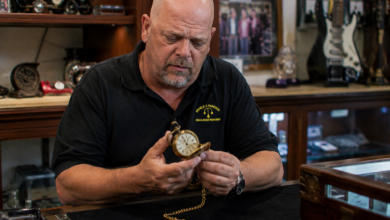
LAS VEGAS, Nev. — To millions of viewers around the world, Rick Harrison appears to have an almost supernatural ability to recognize valuable collectibles within seconds. A customer walks into the Gold & Silver Pawn Shop carrying an old watch, a dusty book, or a rusty military relic, and Harrison often knows immediately whether it’s worth a closer look—or whether it’s simply another ordinary item.
But according to Harrison, there is no magic involved.
His reputation for identifying extraordinary collectibles isn’t built on luck. Instead, it comes from decades of experience, relentless research, and a disciplined process that prioritizes facts over assumptions. While many people focus on how old an object looks or how impressive its story sounds, Harrison says the real clues are often hidden in details that most people never notice.
Experience Is the Greatest Advantage
Before becoming a television personality, Rick Harrison spent decades behind the counter of the Gold & Silver Pawn Shop, which opened in Las Vegas in 1989.
Long before Pawn Stars became a worldwide success, Harrison was evaluating hundreds of items every week. Jewelry, coins, military memorabilia, rare books, historical documents, musical instruments, vintage toys, and antique firearms all passed through his hands.




Over time, he developed what many collectors call an “educated eye.”
Rather than relying on instinct alone, Harrison built an enormous mental library of manufacturers, historical periods, production techniques, and market trends.
That knowledge allows him to recognize unusual details almost immediately.
Clue #1: Provenance Matters More Than Appearance
One of Harrison’s most repeated lessons on Pawn Stars is that every valuable collectible needs a believable history.
Collectors refer to this as provenance—the documented record of an item’s ownership and origin.
An object may appear centuries old, but without evidence connecting it to a particular person, place, or historical event, its value can decline dramatically.
Conversely, an ordinary-looking object with well-documented provenance may become extremely valuable.
Letters, receipts, military records, photographs, auction catalogs, and original purchase documents often increase an item’s desirability because they provide confidence that its story is genuine.
For Harrison, documentation is frequently worth almost as much as the object itself.
Clue #2: Condition Tells a Story
Many first-time sellers assume older automatically means more valuable.
Harrison knows that’s rarely true.
He begins by carefully examining condition.
Has the object been repaired?
Are original parts still present?
Has someone attempted to restore it?
Tiny details—such as replacement screws on a vintage watch or modern stitching on an antique flag—can dramatically influence value.
Sometimes careful aging is natural.
Other times, damage significantly reduces collector interest.
Understanding the difference requires years of experience.
Clue #3: Rarity Alone Isn’t Enough
A common misconception is that rarity guarantees high prices.
Rick Harrison disagrees.
An item can be incredibly rare yet attract very few buyers.
Collector demand ultimately determines market value.
For example, a limited-production advertising sign from a famous brand may generate fierce competition among collectors, while an equally rare industrial component could attract almost no interest.
Before making an offer, Harrison considers not only how rare an object is, but also who might actually want to purchase it.
Business, after all, depends on finding the next buyer.
Clue #4: Authenticity Comes Before Negotiation
Perhaps the most important rule inside the Gold & Silver Pawn Shop is simple:
Never negotiate the price of an item until you’re confident it’s genuine.
This philosophy explains why Pawn Stars regularly features outside experts.
Whether evaluating presidential memorabilia, vintage guitars, historical weapons, sports autographs, or ancient coins, Harrison frequently consults specialists before discussing money.
Authentication protects both the shop and the customer.
It also protects the integrity of the collectibles market.
As counterfeit technology continues improving, professional verification has become increasingly important.
Clue #5: Market Trends Never Stop Changing
The collectibles market evolves constantly.
Items that attracted little attention twenty years ago may suddenly become highly desirable today.
Likewise, markets occasionally cool after periods of intense demand.
Rick Harrison follows auctions, dealer networks, grading reports, and collector communities to understand these changing trends.
Knowledge of current demand allows him to estimate not only what an item is worth today, but also how easily it can be resold tomorrow.
This forward-looking perspective separates experienced dealers from casual collectors.
Knowing When to Walk Away
One lesson viewers often overlook is that some of Harrison’s smartest decisions involve refusing to make a purchase.
Television naturally celebrates spectacular discoveries.
However, successful dealers understand that avoiding costly mistakes is equally important.
If authenticity cannot be confirmed…
If documentation appears questionable…
If restoration costs exceed potential profits…
Or if market demand remains uncertain…
Rick Harrison simply declines the deal.
Walking away protects the business from unnecessary financial risk.
Over thousands of transactions, those careful decisions become just as valuable as successful purchases.
Education Never Ends
Despite decades in the business, Harrison has frequently acknowledged that no one can become an expert in every collectible category.
Instead, he continues learning.
He studies auction catalogs.
He consults museum specialists.
He follows market reports.
He builds relationships with experts around the country.
That willingness to keep learning remains one of the most important reasons for his long-term success.
Knowledge, not confidence alone, creates expertise.
The Television Effect
Pawn Stars has introduced millions of viewers to concepts that were once familiar only to professional collectors.
Terms like provenance, authentication, grading, restoration, and market demand are now commonly discussed among casual enthusiasts.
Many collectors credit the show with encouraging them to research family heirlooms before selling them.
Others have become interested in history after watching experts explain the stories behind unusual artifacts.
The program has demonstrated that understanding an object often proves more valuable than simply owning it.
The Secret Isn’t Luck
To outside observers, Rick Harrison sometimes appears capable of spotting a fortune hidden inside an ordinary box.
In reality, his success is built upon thousands of hours spent studying history, markets, craftsmanship, and human behavior.
Every negotiation begins with questions rather than assumptions.
Every unusual detail receives careful attention.
Every extraordinary claim requires convincing evidence.
Those habits—not luck—have helped transform a small family pawn shop into one of the most recognizable businesses in television history.
For aspiring collectors, Harrison’s approach offers a valuable lesson.
The next million-dollar collectible may not announce itself with glitter or fame.
It may simply reveal its true worth to the person who knows exactly where to look.